
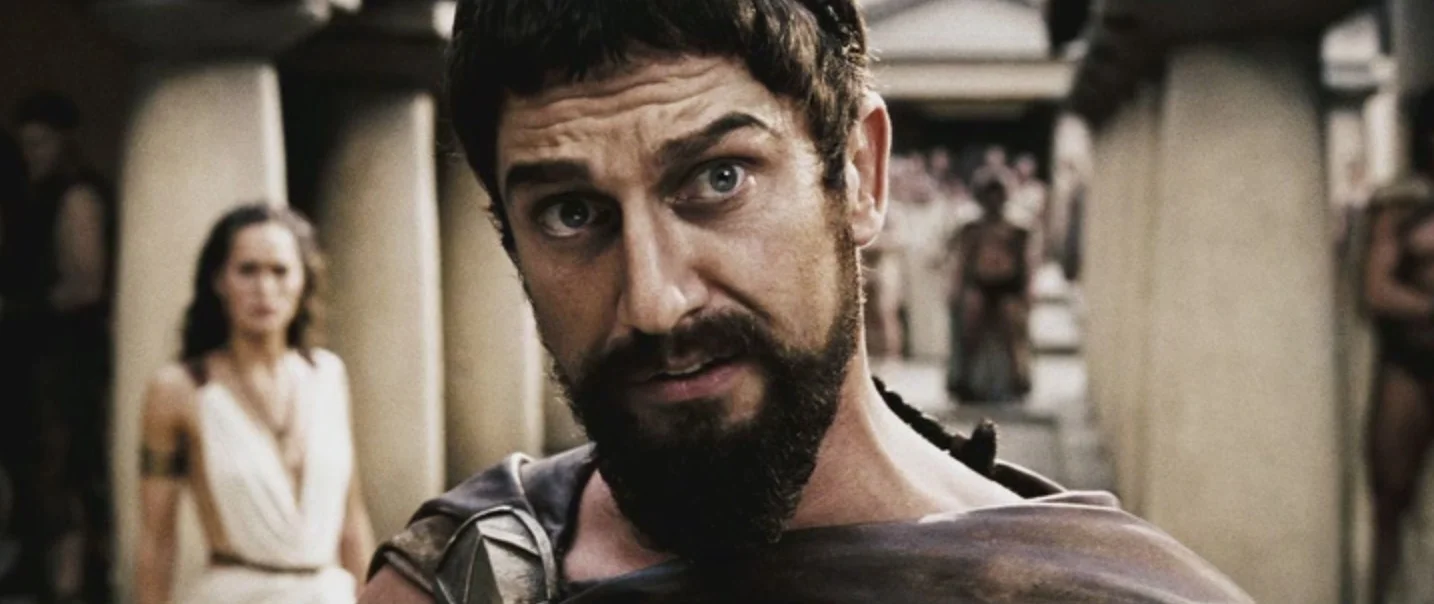

Few historical battles have become as legendary in popular culture as the stand of the Spartan warriors at Thermopylae. The story shown in 300 presents King Leonidas and a small group of fighters holding back the enormous Persian army in a dramatic last stand.
Because the narrative centers on real ancient figures and a famous battle, many viewers naturally wonder how much of what appears on screen reflects actual history and how much comes from storytelling.
The legendary stand of King Leonidas and the Spartans in 300 and why the story feels rooted in history
The central premise of 300 focuses on King Leonidas of Sparta leading a small force of warriors against the massive Persian army commanded by King Xerxes. The film portrays the Spartans as an elite group of highly disciplined soldiers who choose to defend a narrow mountain pass against overwhelming odds.
The story builds its tension around the idea of a heroic last stand. Leonidas and his men know they are outnumbered, yet they decide to hold the pass of Thermopylae in order to slow the Persian advance into Greece. The film emphasizes courage, sacrifice, and loyalty among the Spartan soldiers as they face an army portrayed as nearly unstoppable.
This narrative feels grounded in real history because the Battle of Thermopylae is one of the most famous events from ancient Greek warfare. Historical sources such as the writings of Herodotus describe a Greek force defending the pass against the Persian invasion led by Xerxes in 480 B.C.
Even though the film dramatizes the events heavily, its core idea—Spartan warriors resisting a larger invading army—comes directly from historical accounts. That connection is why the story often appears to be a straightforward retelling of real events, even though many details were changed for dramatic effect.
The real Battle of Thermopylae in 480 B.C. and the Greek resistance against the Persian army
The historical Battle of Thermopylae took place during the second Persian invasion of Greece in 480 B.C. Persian king Xerxes I led a large military campaign across the region in an attempt to bring Greek city-states under Persian control.
Greek forces formed a defensive alliance and chose Thermopylae as a strategic location to resist the invasion. The narrow mountain pass limited the size advantage of the Persian army, allowing a smaller defending force to hold the position more effectively.
Ancient sources describe several Greek contingents participating in the defense, not just Spartans. Soldiers from city-states such as Thespiae and Thebes also took part in the battle. King Leonidas commanded the Spartan contingent, which included 300 elite warriors selected to represent Sparta.
For several days, the Greek defenders successfully resisted the Persian army in the narrow pass. The terrain prevented the Persians from surrounding them easily, allowing the smaller Greek force to fight more effectively.
Eventually, the Persians discovered a mountain path that allowed them to move behind the Greek defenses. This development forced the defenders to confront a situation in which they would be attacked from multiple directions.
King Leonidas of Sparta as a historical figure and the smaller Greek force that fought alongside him
King Leonidas was a real historical ruler of Sparta and a central figure in the Battle of Thermopylae. As one of Sparta’s kings, he commanded Spartan forces during the Greek resistance to the Persian invasion.
The film emphasizes the idea that Leonidas led only 300 Spartan warriors into battle. While it is true that he brought a personal guard of 300 elite Spartans, historical accounts indicate that the total Greek force defending Thermopylae was significantly larger.
Ancient historians estimate that several thousand Greek soldiers were present during the early stages of the battle. These included troops from multiple city-states that joined the Spartan-led defense.
As the battle progressed and the Persian army discovered the mountain path behind the Greek position, Leonidas reportedly dismissed most of the Greek troops. A smaller group, including the Spartans and some allied forces, remained to face the final attack.
The film simplifies these details by focusing almost entirely on the Spartans. This choice strengthens the dramatic narrative of a small group of warriors making a heroic stand but removes the broader coalition that actually fought at Thermopylae.
Ephialtes and the betrayal that allowed Persian forces to outflank the defenders at Thermopylae
One of the key turning points in the historical battle involved a local Greek named Ephialtes. According to the historian Herodotus, Ephialtes revealed the existence of a mountain path that allowed the Persian army to move behind the Greek defenses.
This path, known as the Anopaia trail, gave the Persians a strategic advantage. By using the route, they were able to surround the defenders at Thermopylae rather than continuing to attack them directly from the front.
The film includes Ephialtes as a character but presents him in a very different way. In the movie, he appears as a physically deformed Spartan outcast who betrays Leonidas after being rejected from the army.
Historical sources do not describe Ephialtes in this manner. Instead, he was likely a local resident who provided information to the Persian forces. His motivations are not described in detail in ancient records.
The presence of betrayal in both the historical event and the film helps maintain a connection between the story and real history, even though the portrayal of the character is heavily dramatized.
Frank Miller’s graphic novel as the main source shaping the film’s visual style and story
Although 300 depicts real historical figures and events, the film’s immediate source is not a historical text. Instead, it is based on a graphic novel created by writer and artist Frank Miller in 1998.
Miller’s graphic novel presents the story of Thermopylae through a highly stylized visual and narrative approach. The artwork exaggerates the physical appearance of warriors, armor, and battles in order to create a mythic atmosphere.
The film adaptation follows this stylized interpretation closely. Many scenes reproduce the graphic novel’s visual compositions and dramatic tone rather than attempting to recreate ancient Greece with historical accuracy.
As a result, the film reflects Miller’s interpretation of the historical legend more than it reflects the historical sources themselves. The emphasis on dramatic imagery, exaggerated characters, and myth-like storytelling comes from the graphic novel rather than from ancient records.
Mythical creatures, exaggerated warriors, and other elements that depart from historical records
Several elements in the film clearly depart from documented history. The Persian army in the movie includes unusual figures such as giant warriors, masked executioners, and other characters designed to appear almost supernatural.
These visual elements do not appear in historical accounts of the Persian army. Ancient sources describe the Persians as a large and diverse force composed of soldiers from different regions within the Persian Empire, but not as mythical creatures or monstrous fighters.
The film also exaggerates the scale and style of combat. Spartan warriors are portrayed as nearly unstoppable fighters capable of defeating large numbers of enemies with ease.
Historical battles were far more complex and involved coordinated formations and strategies used by both sides. The film simplifies these dynamics to focus on individual acts of heroism.
These choices demonstrate that the story prioritizes visual storytelling and dramatic symbolism rather than strict historical accuracy.
What historians confirm about Thermopylae compared with the dramatic version shown in 300
Historians generally agree on several key facts about the Battle of Thermopylae. The conflict occurred in 480 B.C. during the Persian invasion of Greece, and a Greek force led by King Leonidas defended the mountain pass against a larger Persian army.
Historical accounts also confirm that the defenders successfully held the pass for several days before being outflanked through a mountain path revealed to the Persians. Leonidas and a group of remaining soldiers stayed behind to fight while other Greek troops withdrew.
However, historians also emphasize that the battle involved multiple Greek city-states rather than only Spartans. The event was part of a broader war between the Greek alliance and the Persian Empire.
The scale of the Persian army and the number of Greek defenders remain topics of debate among scholars. Ancient writers sometimes exaggerated numbers to emphasize the dramatic nature of the battle.
The film condenses these complexities into a more simplified narrative centered on Spartan heroism.
300 as a heavily fictionalized retelling inspired by a real ancient battle rather than a historically accurate account
The story shown in 300 draws inspiration from a real historical battle, the stand of Greek forces at Thermopylae during the Persian invasion of 480 B.C. The presence of King Leonidas, the narrow mountain pass, and the betrayal that allowed the Persians to flank the defenders all come from historical accounts.
At the same time, the film presents these events through a highly stylized interpretation influenced by Frank Miller’s graphic novel. Characters are exaggerated, battles are dramatized, and many details are altered or invented.
The result is a narrative that captures the legend of Thermopylae rather than the historical reality. The film reflects the spirit of a famous ancient story about resistance and sacrifice, but its portrayal of events and characters should not be understood as a historically accurate depiction of the battle.
