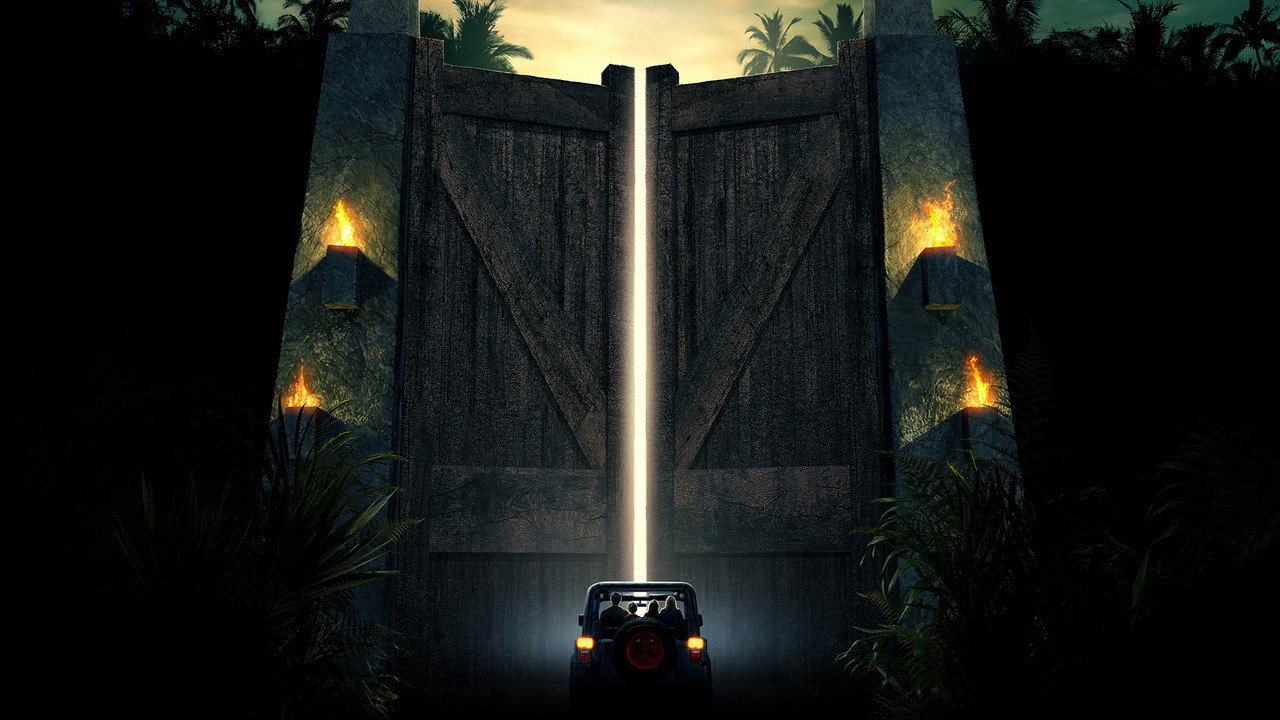

Steven Spielberg’s Jurassic Park is often remembered as a dinosaur spectacle, but the movie is just as notable for how carefully it builds fear, wonder, and scientific curiosity at the same time. The story’s setting, Isla Nublar, lets the film move from calm museum-like introductions to full-scale chaos, and that contrast is one reason the movie still feels unusually strong as a piece of popular storytelling. It is also a movie where the details matter: the way the animals are introduced, the way the human characters are grouped, and the way the park itself is designed all help turn a straightforward premise into something memorable.
What makes Jurassic Park especially interesting is that many of its most famous moments are not random thrills but carefully built storytelling beats. The film gives each major character a specific role in the conversation about science, ethics, control, and survival, then uses the dinosaurs to test those ideas. Even viewers who know the movie well often overlook how much of its impact comes from disciplined design choices rather than sheer scale alone. Here are ten facts and observations that help explain why the film has lasted so long.
The dinosaurs are introduced like living exhibits before they become threats
One of the movie’s smartest choices is that it does not begin by treating the dinosaurs as monsters. The first major encounters are framed almost like museum displays or nature-documentary reveals, especially the brachiosaurus sequence, which emphasizes awe before danger. That approach matters because it lets the audience experience the same emotional shift as the characters: first amazement, then disbelief, then caution.
This structure also reflects the park’s own pitch. In-universe, Jurassic Park is supposed to be a controlled, premium attraction, so the film spends real time on the idea of curation. The dinosaurs are not just visual effects; they are part of a corporate showpiece, and the movie makes the spectacle feel polished before showing how fragile that polish really is.
Dr. Alan Grant and Dr. Ellie Sattler are defined by their different scientific instincts
Sam Neill’s Alan Grant and Laura Dern’s Ellie Sattler are both paleontologists, but the film gives them distinct ways of seeing the world. Grant is initially skeptical, practical, and deeply focused on fossils and field reality, while Sattler is more immediately willing to confront the implications of what the park represents. Their professional expertise is not background decoration; it shapes how they respond to the park’s claims.
That difference also makes their reactions feel grounded. Grant’s amazement at living dinosaurs carries extra weight because he has spent his life studying creatures that no longer exist. Sattler, meanwhile, is often the one who notices the ecological and operational problems behind the shiny presentation. Together, they give the film two complementary scientific viewpoints rather than a single “expert” perspective.
Ian Malcolm turns the movie’s warning into a memorable personality
Jeff Goldblum’s Ian Malcolm is not just the guy who says “life finds a way”; he is the film’s built-in challenge to the park’s entire philosophy. As a mathematician and chaos theorist, he is written as someone who understands that complex systems fail in ways planners cannot fully predict. That makes him the clearest verbal expression of the movie’s central theme: control is an illusion when nature is involved.
Malcolm is also unusually useful dramatically because he delivers warnings in a way that is characterful, not preachy. He is sarcastic, impatient, and visibly unconvinced by the park’s confidence, which helps his objections feel human rather than abstract. The movie uses him to turn a scientific argument into a vivid personality clash, and that makes the warnings land harder.
The children are not just audience surrogates
Lex and Tim Murphy are often remembered as the children in peril, but they are also important to the movie’s structure. Tim’s fascination with dinosaurs gives the film a childlike sense of wonder, while Lex’s more practical, stressed-out responses help balance the tone once the park fails. They are written as capable enough to matter but vulnerable enough to keep the danger immediate.
Because the story places them with the adults during several major crisis scenes, the movie can shift between technical problem-solving and family survival without feeling forced. Their presence also makes the stakes more personal for John Hammond, whose dream of a perfect park collides with the reality that his own grandchildren are now trapped in it. That family connection gives the catastrophe an emotional center.
John Hammond is not a simple villain
Richard Attenborough’s John Hammond is ambitious, controlling, and dangerously overconfident, but the film does not treat him as a cartoon antagonist. He genuinely believes he is creating wonder, and in several scenes he comes across as delighted by the same marvels the audience is meant to admire. That makes him more unsettling than a straightforward greedy businessman, because his mistakes come from certainty rather than obvious malice.
The movie also gives Hammond a specific kind of blindness: he understands presentation better than consequence. He knows how to host, impress, and narrate an experience, but he consistently underestimates the systems needed to keep that experience safe. That gap between image and reality is one of the film’s sharpest ideas, and Hammond embodies it from beginning to end.
The park itself is designed as a high-tech promise that keeps failing
Jurassic Park’s physical spaces are crucial to the film’s tension. The visitor center, control rooms, vehicle routes, and paddocks all suggest a place built to manage perception as much as animals. Clean lines, glass, screens, and elevators create the feeling of modern mastery, which makes every breakdown feel more dramatic because the environment itself is supposed to represent total control.
The movie repeatedly turns that design against the characters. Doors that are meant to secure the park become traps, screens that are meant to monitor danger go dark, and boundaries that are supposed to separate humans from dinosaurs disappear. The setting is not just a backdrop; it is a machine that stops working, and the story uses that failure to make the entire premise collapse in stages.
The T. rex sequence remains one of the film’s best examples of suspense construction
The Tyrannosaurus rex attack works because the film spends time making the enclosure feel stable before it breaks. Rain, darkness, mechanical failure, and the contrast between sound and silence all build dread before the dinosaur is fully visible. The sequence is famous for its scale, but its real strength is pacing: the movie makes the audience wait long enough to feel the consequences of every small malfunction.
It is also a great example of how the film balances practical effects and digital imagery in service of a single scene. Rather than letting the creature simply appear, the movie stages a series of partial reveals—movement in the water, vibrations, shifting light, torn structures—so the T. rex feels physically present before the full attack begins. The result is a sequence that still reads as carefully composed, not merely loud.
Science, ethics, and entertainment are always in the same conversation
What keeps Jurassic Park from becoming a simple disaster movie is the way it links scientific achievement to moral responsibility. The dinosaurs are extraordinary, but the film constantly asks who should control them, how they should be studied, and whether creating them was wise in the first place. The park’s collapse is thrilling, but it is also treated as a failure of judgment.
That’s why the movie’s most memorable lines and scenes are often tied to philosophy as much as action. The characters are not only escaping predators; they are confronting the limits of human planning. By making the story about wonder, arrogance, and consequence all at once, the film gives its dinosaur adventure a lasting edge that goes well beyond spectacle.