
James Cameron’s Titanic is famous for its romance and disaster, but one of the movie’s most impressive achievements is how completely it rebuilt the ship’s world from the inside out. The film does not just use the Titanic as a backdrop; it turns the ship itself into a central dramatic force, with grand public spaces, cramped crew areas, and the social divide between first- and third-class passengers all made visible in the production design. That sense of scale is a major reason the movie still feels immersive decades later.
The story also depends on careful attention to how the ship moves through space and time. The movie begins in 1996 with the recovery expedition, then shifts into Rose DeWitt Bukater’s memories of 1912, where the ship becomes both a luxury liner and a sealed stage for class conflict, youthful freedom, and impending catastrophe. By the time the iceberg strikes, the audience has already learned the layout of the ship well enough to understand how people can be separated, trapped, or forced into impossible choices.
A ship recreated through sets, scale, and structure
The Titanic in the movie is not presented as a single giant background model. It appears through multiple forms: full-scale sets, partial ship sections, miniature work, and digital extensions. That layered approach helps the movie create the illusion of a huge vessel without ever feeling abstract. When the camera glides along corridors or across the grand staircase, the environment feels physically walkable, not merely decorative.
Some of the film’s most recognizable spaces are also the ones that best express the movie’s themes. The grand staircase is polished, symmetrical, and ceremonial, while third-class areas are more crowded and utilitarian. The contrast is not subtle, but it is effective because it turns class into architecture. You can see the difference in airflow, decoration, and access long before the plot spells it out.
The production design makes social rank visible
Titanic repeatedly uses rooms, corridors, and doors to show who belongs where. First-class passengers move through ornate dining rooms, private suites, and public spaces designed to display wealth. Third-class passengers, by contrast, are associated with music, cramped quarters, and social energy rather than luxury. The ship’s layout reinforces the rigid structure of the early 20th-century world the movie is depicting.
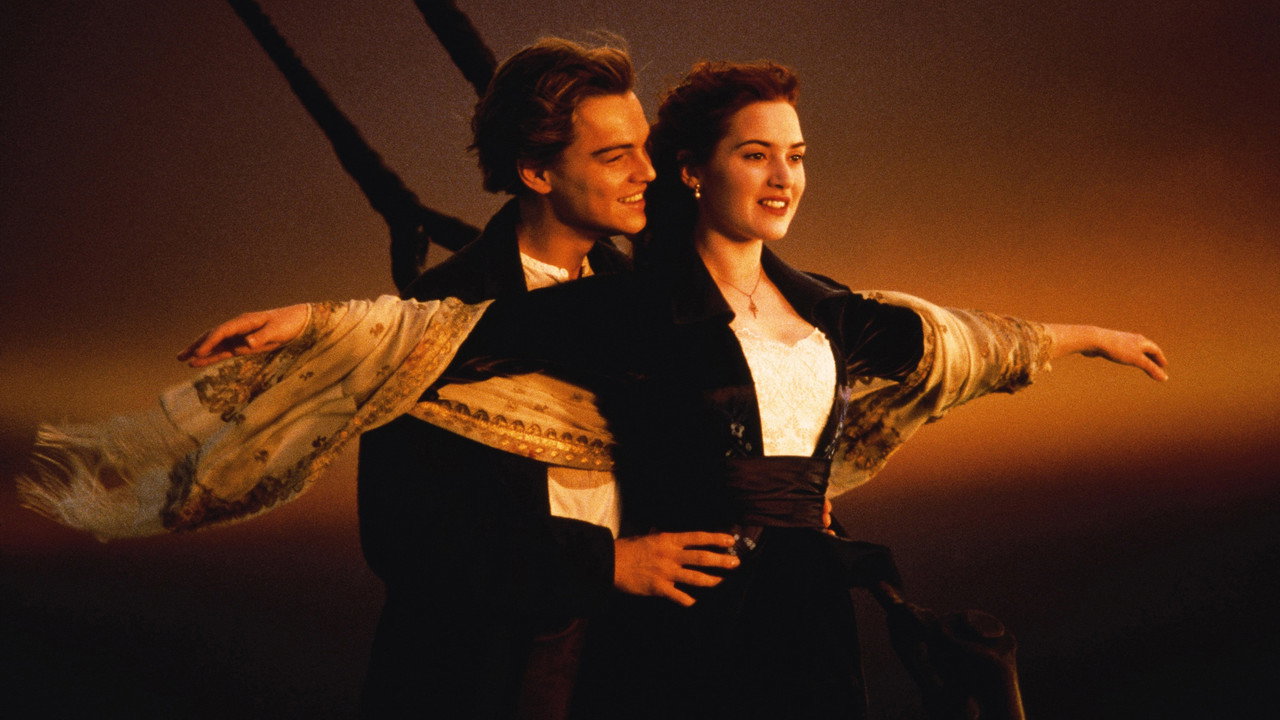
This visual hierarchy matters because the film’s central romance crosses it. Rose and Jack’s relationship is not only about personal attraction; it is staged as a breach in the ship’s built-in order. Every glance across a railing, every shift from one deck to another, and every attempt to cross class boundaries carries extra meaning because the Titanic itself is designed to keep people apart.
James Cameron uses the ship as a moving clock
The movie’s famous suspense does not rely only on the iceberg impact. Long before that, the ship is presented as a machine in motion, with routines, procedures, and confidence building toward a fixed end. Rose’s retrospective narration gives the audience knowledge the characters do not have, which makes ordinary scenes on board feel charged. The ship is not just traveling through the North Atlantic; it is moving toward a known historical endpoint.
That structure gives the movie a distinctive rhythm. There are scenes of courtship, dinners, dances, and private conversations, but they are never fully separated from the looming disaster. Even moments of glamour are shadowed by the audience’s awareness of what the Titanic will become. The film’s emotional power comes partly from that tension between immediate experience and historical inevitability.
Rose and Jack are shaped by their places on the ship
Rose DeWitt Bukater and Jack Dawson are written as opposites in background, but the movie carefully gives each of them a relationship to the Titanic that goes beyond simple class labels. Rose is surrounded by luxury yet feels trapped by expectations, engagement, and family pressure. Jack has freedom, but he is vulnerable to the limits of third-class life and the dangers that follow from being lower on the ship’s social ladder.
Their meeting works because the movie connects personal desire to physical movement. Jack shows Rose new spaces on the ship, from open decks to livelier third-class gatherings, while Rose exposes Jack to first-class rituals and the etiquette that governs them. Their relationship is not a fantasy of escape from history; it is a temporary crossing of boundaries that the ship itself is built to police.
The disaster scenes rely on both emotion and engineering
When the Titanic begins to sink, the film shifts from elegant spectacle to tightly controlled chaos. The wreck is staged as a sequence of escalating failures: water compartments give way, corridors flood, stairs and hallways become unusable, and the ship’s tilt changes every movement into a struggle. The action is dramatic, but it is also spatially coherent, so the audience can keep track of where characters are and how their routes narrow.
The movie’s most memorable images during the sinking come from that combination of human panic and mechanical scale. People cling to railings, crowd staircases, and face impossible choices about where to go. The ship’s design, which once signaled comfort and prestige, becomes an instrument of danger. What was built to organize life aboard the Titanic ends up organizing its destruction.
Historical figures appear alongside fictional ones
Though Titanic centers on Rose and Jack, it also includes real historical figures from the ship’s final voyage, such as Captain Edward Smith, White Star Line owner J. Bruce Ismay, and shipbuilder Thomas Andrews. Their presence gives the story a broader historical frame and helps connect the fictional romance to the actual passenger list and command structure of the ship.
The movie uses these figures differently from the main characters. They are not given the same emotional arc as Rose and Jack, but they help ground the drama in the realities of the voyage: command decisions, engineering limitations, and the hierarchy aboard the liner. Their inclusion also reminds viewers that the tragedy was not just a private story of a few passengers, but a catastrophe affecting many different social worlds at once.
Music, movement, and memory keep the ship alive
Several of the film’s most enduring scenes depend on repetition and ritual rather than action alone. Dances, dining scenes, and the musicians’ presence aboard the ship help create a lived-in sense of time passing. These sequences make the Titanic feel inhabited, not merely observed. The audience gets a sense of what daily life aboard the ship might have felt like before disaster overtakes it.
Rose’s memories frame these moments as preserved fragments, which is why the film often feels elegiac. The ship is not only a physical object in the story; it is also a vessel for memory. That idea is reinforced by the film’s structure, which moves between old age and youth, between recovery and recollection, and between the wreck and the ship as it once stood in motion. The Titanic survives in the movie as both a place and an experience, carefully reconstructed so the audience can enter it, understand it, and then watch it disappear.