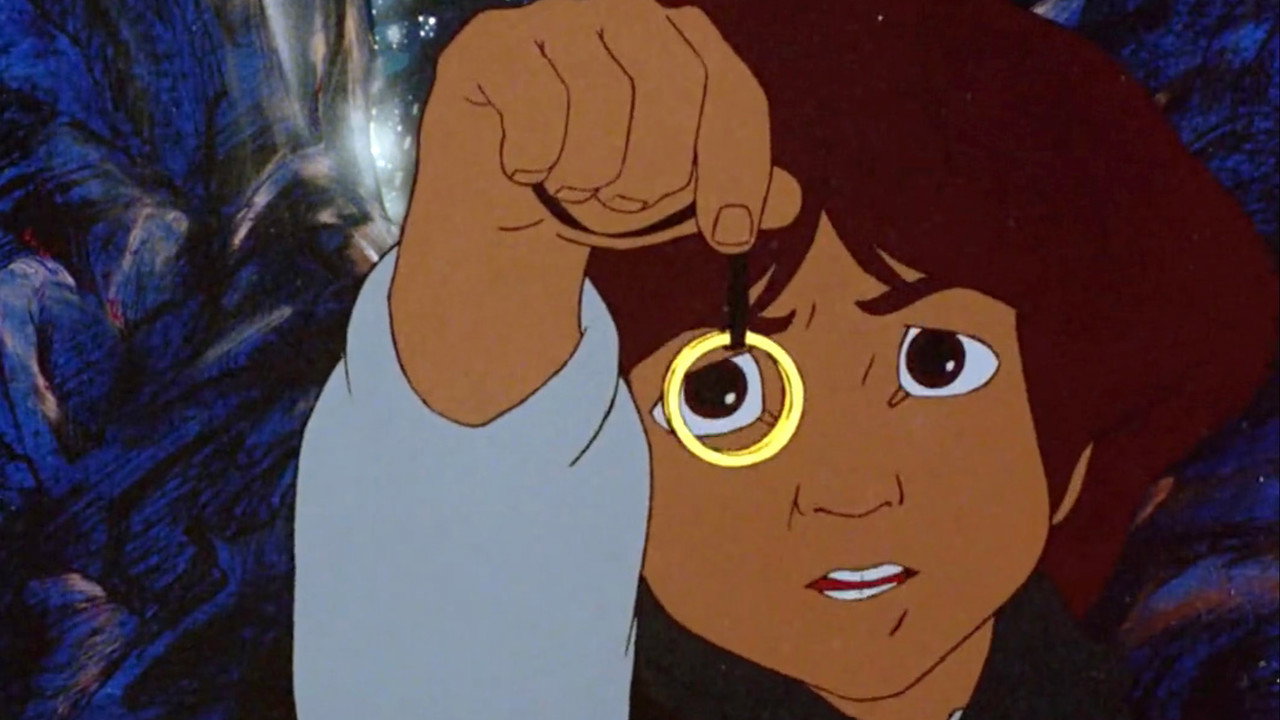

Ralph Bakshi’s The Lord of the Rings brought J.R.R. Tolkien’s world to animation in 1978, but its most striking achievement is how often it makes painted backgrounds, miniature scenery, and layered photographic effects feel like a real landscape. Long before digital compositing became standard, the film had to suggest the size of Middle-earth with camera tricks, hand-built models, and careful staging. The result is a movie that can make a fortress seem vast, a mountain road feel perilous, and a battlefield appear much larger than the image frame itself.
That illusion of scale matters because Tolkien’s story depends on distance, height, and geography as much as on swords and sorcery. The Fellowship is small and vulnerable; Mordor is huge and oppressive; the journey itself is one long test of how far a few figures can travel against enormous odds. The 1978 adaptation uses miniature sets not just as a technical solution, but as a visual language for that imbalance. Even when the style is rough-edged, the production is constantly trying to put tiny characters inside spaces that feel ancient, dangerous, and bigger than life.
Miniatures gave the film its mountains, fortresses, and battle spaces
Because the movie could not always build full-scale environments for every location, miniature sets helped create the grand architecture of Middle-earth. Towers, walls, cliffs, and roadways could be constructed in reduced form and then photographed in ways that made them appear much larger on screen. This allowed the film to stage characters against imposing structures without requiring a full-size construction for every angle.
The effect is especially important in sequences that depend on scale contrast. When a tiny figure crosses a bridge, approaches a gate, or moves through a narrow pass, the surrounding environment has to feel physically massive. Miniatures make those spaces look deep and vertical, which gives the movie the sense of being set inside a world that dwarfs its travelers.
Painted backdrops extended the world beyond what the camera could capture
Miniatures were only part of the illusion. The film also relied on painted scenery and stylized backgrounds to widen the frame beyond the built elements. Those painted extensions helped turn a limited set into a larger landscape, whether the scene needed distant mountains, a glowing horizon, or a sense that a structure continued far past what the viewer could actually see.
This approach is especially effective in animated cinema, where the line between drawn and constructed imagery can be blended. In The Lord of the Rings, the painted and miniature elements often work together so the eye reads them as one environment. That unity is crucial for a story that moves from quiet rural spaces into looming citadels and volcanic terrain.
Forced perspective and careful framing made objects seem larger than they were
One of the oldest scale tricks in filmmaking is also one of the most useful: place objects at different distances from the camera so they appear to belong to the same world while actually being different sizes. In a film like this, that kind of staging can make a tiny structure appear monumental, or make a figure seem to stand far below a massive wall. The camera becomes part of the illusion, deciding what the audience reads as foreground and background.
That matters for Tolkien’s settings because many of them are defined by overwhelming size. The Mines of Moria, the halls of Rivendell, and the dark strongholds of the enemy all need to feel more immense than a straightforward drawing would suggest. Forced perspective and controlled framing help the film build that scale without sacrificing the stylized look of the animation.
The film’s scale effects support the contrast between hobbits and the rest of Middle-earth
The story centers on Frodo Baggins, a hobbit whose physical smallness is one of the defining facts of the tale. Miniature environments reinforce that idea even when the movie is not explicitly emphasizing size differences between characters. When the world around Frodo feels oversized, his vulnerability becomes more concrete. He is not just a reluctant hero; he is a small figure moving through spaces designed to overwhelm him.
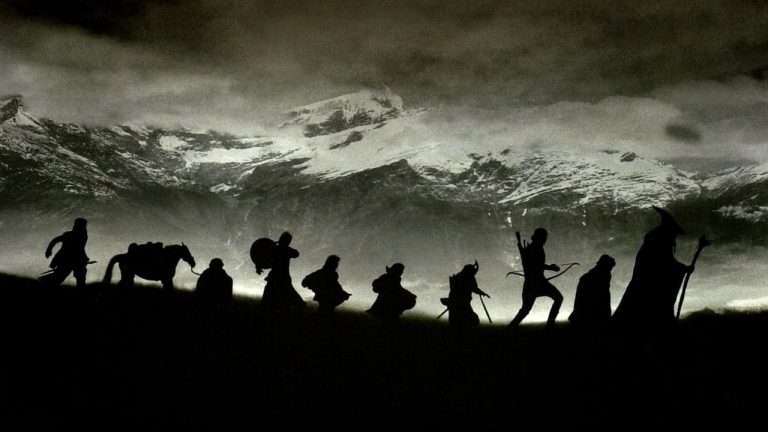
That contrast extends to the Fellowship as a whole. Aragorn, Boromir, Gandalf, Legolas, Gimli, and the others are all framed against settings that can feel ancient and towering. The scale of the environment makes their alliance seem hard-won and fragile, as though the world itself is stacked against them. Miniature design helps translate that theme into something visible in nearly every travel sequence.
Battle scenes depend on scale to make armies feel crowded and dangerous
The movie’s combat often has to suggest far more fighters than could be shown through individual character animation alone. Miniature battlegrounds, combined with layered movement and crowd-like staging, let the film hint at mass conflict. Even when the number of figures on screen is limited, the terrain around them can imply a much larger war unfolding just outside the frame.
That technique is useful in a fantasy story because scale does not only mean distance or height. It also means numbers, pressure, and momentum. A bridge crowded with enemies, a courtyard ringed by walls, or a slope leading into a fortress can make a relatively small skirmish feel like part of a larger campaign. Miniature sets help the movie give its battles that sense of density.
Miniatures fit the film’s stylized animation rather than fighting it
The Lord of the Rings is not aiming for photorealism in the modern sense, so its scale effects do not need to disappear into invisibility. Instead, the miniatures contribute to the film’s illustrated, storybook quality. Because the movie already uses bold visual simplification, the reduced sets can become part of the aesthetic rather than a hidden technical compromise.
That is one reason the film’s visual world feels unusual even now. The miniatures do not merely imitate reality; they help create a version of Middle-earth that feels carved, painted, and imagined. The audience is aware, at some level, that what it is seeing is constructed, but the construction itself becomes part of the fantasy atmosphere.
The illusion of scale helps unify the journey from the Shire to Mordor
The story covers a long and dangerous route, and the production has to make each new region feel distinct. Miniature sets and scale effects are useful because they can turn geography into a series of memorable images: a remote path, a guarded gate, a cliffside approach, a chamber of stone, a dark volcanic horizon. The film does not just move the characters across a map; it changes the size and shape of the world around them.
That gives the journey a cumulative feeling. As Frodo and the Fellowship move closer to Mordor, the settings grow harsher and more intimidating, and the scale of the images reflects that emotional pressure. The world seems to close in, even when the vista becomes larger, because every impressive structure also feels like a threat. The miniature work is doing narrative work at the same time, turning environment into tension.
The movie’s craftsmanship shows how fantasy filmmaking worked before digital tools
Today, a studio might build the same kinds of environments with visual effects, digital matte paintings, and computer-generated crowds. In 1978, those solutions were not available in the same form, so the production had to combine practical filmmaking methods to achieve comparable results. Miniatures were one of the most important tools in that toolkit, allowing the movie to widen its world without losing the hand-crafted look that defines it.
That makes The Lord of the Rings a useful example of pre-digital fantasy craft. The film’s scale illusions are not seamless in the modern blockbuster sense, but they are expressive and often striking. They show how a fantasy adaptation can use physical models, painted extensions, and deliberate camera design to make Middle-earth feel large enough for a legendary quest. In that sense, the miniatures are not just background detail; they are part of the movie’s storytelling grammar.