
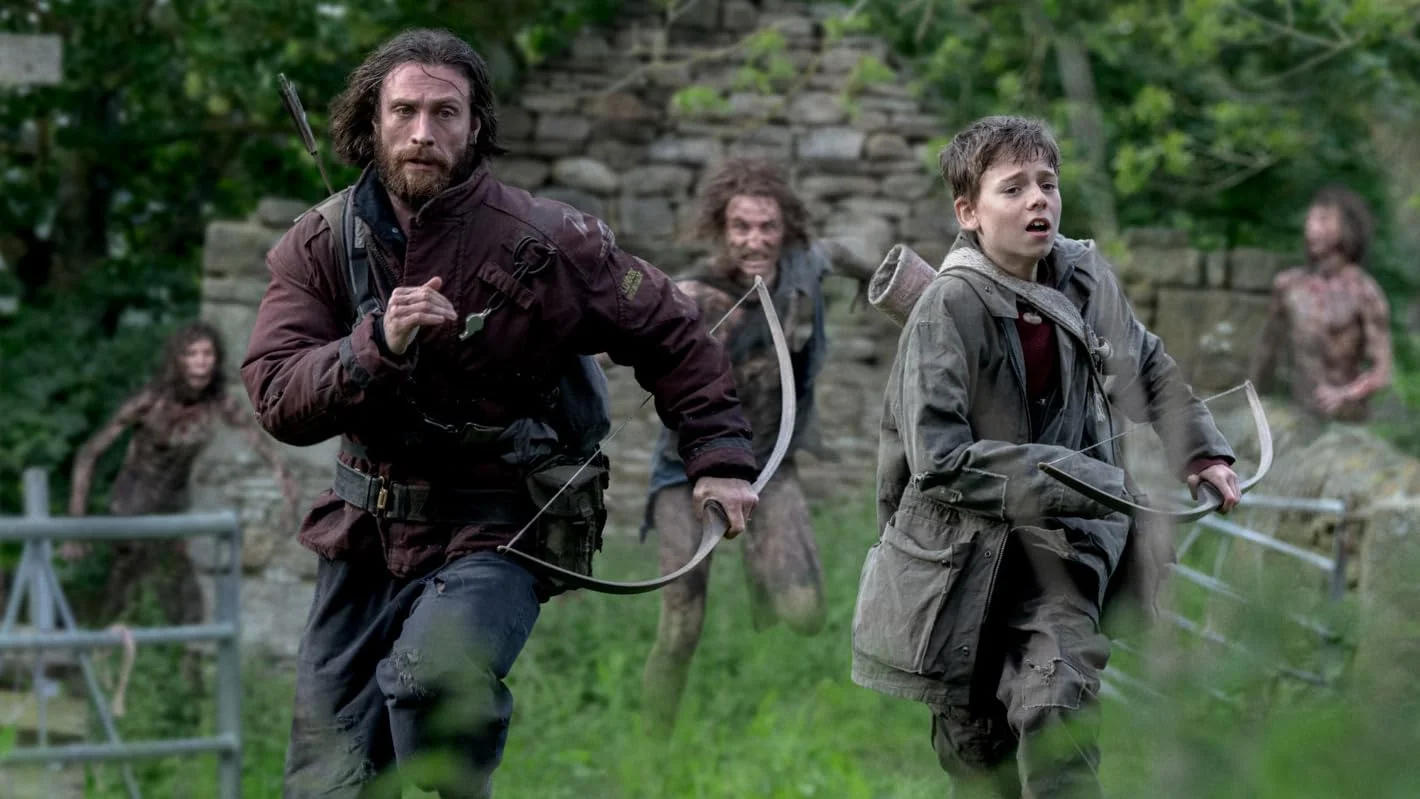

Anyone considering 28 Years Later (2025) is likely weighing whether returning to a long-dormant post-apocalyptic world is still compelling.
The story takes place decades after the original outbreak, focusing less on shock value and more on how survivors have adapted to a permanently altered society. The pace alternates between quiet tension and bursts of violence, creating an experience that is more reflective than relentless.
A Return to the Rage Virus World That Feels More Reflective Than Constantly Chaotic
Rather than reopening the story with nonstop panic, the film shows a landscape shaped by years of survival. Communities have formed, routines exist, and people have learned to live with constant danger. Scenes often emphasize abandoned infrastructure, reclaimed land, and improvised settlements, giving a sense that time has passed even if safety has not returned.
This approach creates a slower, more contemplative tone compared to the frantic energy of the earlier outbreak period. The world feels worn down rather than explosive. For viewers interested in how societies rebuild after catastrophe, these details provide depth. Those expecting continuous action may initially find the calm unsettling or even subdued.
The Survival Storyline That Keeps the Stakes Personal and Immediate
The core narrative follows a small group navigating both infected zones and fragile human territories. Their objective is not to defeat the virus but to accomplish a specific survival task, such as reaching a safe location or securing resources. This keeps the focus on individual decisions rather than grand strategy.
Because the story centers on recognizable human needs—food, shelter, safety—the stakes remain easy to understand. Emotional investment comes from watching how characters react under pressure rather than from large-scale spectacle. Losses and setbacks feel consequential because they directly affect the group’s ability to continue.
New Characters and Shifting Alliances That Sustain Interest
Since decades have passed, most of the cast consists of new figures shaped by a world where the outbreak is ancient history rather than a recent trauma. Their perspectives differ from survivors who remember normal life. Some view the infected as a natural hazard, while others treat them as an enemy to be eradicated.
Relationships evolve as the journey progresses. Temporary alliances form out of necessity, and trust remains fragile. Encounters with other groups introduce competing priorities, sometimes forcing difficult choices. These interactions keep the narrative moving even when action is minimal, as the tension shifts from physical danger to human unpredictability.
Action Sequences and Outbreak Encounters That Deliver the Expected Intensity
When violence erupts, it does so quickly and without warning. Encounters with infected individuals are chaotic and brutal, emphasizing speed and unpredictability rather than prolonged combat. These scenes provide the adrenaline spikes associated with the series, reminding viewers that the threat remains lethal.
Practical effects and grounded staging make the danger feel immediate. Characters are often outnumbered and must rely on improvisation rather than superior firepower. The contrast between quiet travel and sudden attack heightens the impact of these moments, preventing the story from becoming static.
Slower World-Building Passages That May Test Patience
Extended sequences focus on travel, observation, and conversation about how the world functions now. These passages reveal how communities govern themselves, how trade occurs, and what dangers exist beyond infected individuals. While informative, they can slow momentum.
Viewers expecting a constant survival sprint may find these sections meandering. The narrative occasionally pauses to show landscapes or daily routines without immediate payoff. For some, this deepens immersion; for others, it may feel like the story is delaying major developments.
How the Tone Differs from Earlier Entries in the Series
Earlier installments emphasized the shock of collapse and the terror of the unknown. In contrast, this film explores endurance. Fear remains present, but it is less about sudden apocalypse and more about living with irreversible loss. Characters are not discovering the world has ended—they have grown up in its aftermath.
This tonal shift may surprise viewers expecting the same relentless dread. The film replaces chaos with resignation and cautious hope, making it feel closer to a survival drama than a pure horror experience. Those open to this evolution may find it more emotionally grounded, while others may miss the raw intensity of earlier stories.
Who Will Connect Most with This Bleak Post-Pandemic Setting
The film is most likely to resonate with viewers who appreciate character-driven survival narratives. People interested in societal collapse, long-term consequences, and human adaptation to disaster will find substance in the quieter moments. Fans of the original series who want to see how the world has changed rather than relive the outbreak itself may also connect strongly.
Conversely, audiences seeking straightforward action or frequent scares may struggle with the measured pace. The emphasis on atmosphere, relationships, and ethical dilemmas requires patience and attention.
Whether the Journey Through This Ruined World Feels Worth the Time
Taken as a whole, the experience offers a thoughtful continuation rather than a simple repetition of past thrills. The film balances intense encounters with extended periods of reflection, creating a rhythm that prioritizes realism over spectacle. Strong performances and credible character behavior help maintain engagement even during slower sections.
However, the deliberate pacing and subdued tone may not satisfy viewers hoping for constant tension. The narrative demands emotional investment and tolerance for uncertainty. For those willing to accept a quieter, more mature approach to the infected-world premise, 28 Years Later (2025) provides a meaningful and absorbing experience. For most viewers interested in survival drama with occasional bursts of action, it is worth watching.
Other Infection-Driven Survival Stories to Try If This One Isn’t the Right Fit
- The Last of Us (2023– ) — Focuses on a cross-country journey through a devastated world with strong character relationships at its core.
- 28 Weeks Later (2007) — Offers a faster-paced continuation centered on military containment and renewed outbreak chaos.
- Children of Men (2006) — Presents a bleak future society where survival hinges on protecting a single fragile hope.
- Train to Busan (2016) — Delivers relentless action within a confined setting as passengers fight to survive a rapid outbreak.
- A Quiet Place (2018) — Explores family survival in a hostile environment where silence becomes the primary defense.
