
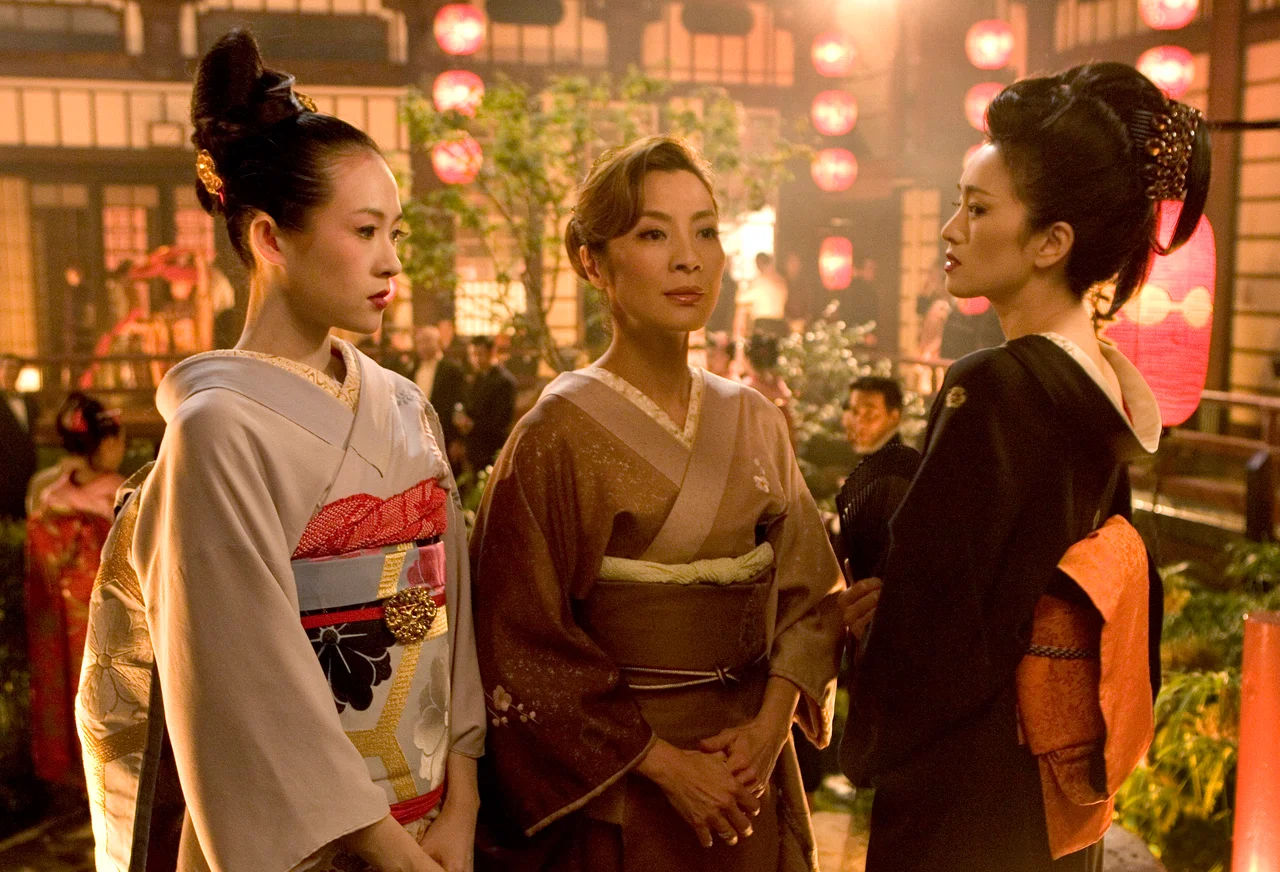

Stories set in the world of geisha often feel grounded in history, which makes Memoirs of a Geisha seem like it could be drawn directly from real life.
The film follows a young girl sold into a geisha house who rises through hardship to become one of Kyoto’s most sought-after entertainers. That sense of detail and realism raises a natural question about how much of it actually reflects true events and how much was created for storytelling.
The idea of a geisha’s life as portrayed in Memoirs of a Geisha and its link to reality
Memoirs of a Geisha presents a structured view of geisha life in early 20th-century Japan, focusing on training, hierarchy, and the social role of these women. The film shows young girls entering okiya houses, learning traditional arts, and competing for status within a tightly controlled environment.
These elements are based on real aspects of geisha culture. Historically, geisha were trained entertainers skilled in music, dance, and conversation, often beginning their training at a young age. The film reflects this framework with reasonable accuracy in terms of structure and setting. However, it organizes these details into a clear narrative arc centered on personal struggle and ambition, which simplifies the broader and more varied reality of geisha life.
The fictional character of Sayuri and how her story is constructed
Sayuri, the central character, is not a real historical figure. Her life story—from being sold as a child to becoming a celebrated geisha—is entirely fictional, though it is presented in a way that mimics a personal memoir.
The narrative follows a classic progression: hardship, rivalry, mentorship, and eventual success. This structure gives the impression of a documented life story, but it is a literary creation designed to guide the audience through the world of geisha. The specific events in Sayuri’s life, including her relationships, conflicts, and ultimate outcomes, are not tied to any single real person.
The influence of Mineko Iwasaki on the creation of the novel
The story behind Memoirs of a Geisha does have a real-world connection through Mineko Iwasaki, one of Japan’s most famous geisha. The author of the original novel, Arthur Golden, interviewed Iwasaki during his research process and used her insights to build parts of the narrative.
Iwasaki later stated that her experiences were misrepresented in the book, particularly regarding the portrayal of geisha practices and personal relationships. She also published her own autobiography to clarify her life story and correct what she saw as inaccuracies. While her experiences helped inform the setting and certain details, the final story diverges significantly from her actual life.
What real geisha traditions and settings are accurately represented
The film captures several authentic aspects of geisha culture, especially in its visual and environmental details. The setting of Kyoto’s Gion district, the use of traditional clothing such as kimono, and the emphasis on artistic training are all grounded in historical reality.
The progression from apprentice (maiko) to full geisha is also depicted in a way that aligns with known practices. The importance of reputation, sponsorship, and performance within elite social circles reflects how geisha operated within Japanese society.
These elements contribute to the film’s sense of authenticity, even though they are placed within a fictional storyline.
Where the story dramatizes or alters the daily life of a geisha
While the film uses real cultural elements, it amplifies certain aspects for dramatic effect. Rivalries between geisha, for example, are presented as intense and personal conflicts, whereas in reality, relationships within geisha communities were often more structured and professional.
The film also emphasizes themes of romantic longing and personal struggle in ways that are not central to documented geisha experiences. Certain plot points, such as the idea of a single life-defining love story shaping a geisha’s path, are narrative inventions rather than reflections of typical real-life situations.
These changes create a more emotionally driven story but move the narrative further away from historical accuracy.
Differences between documented geisha experiences and the film’s narrative choices
Historical accounts from geisha themselves, including Mineko Iwasaki, describe a profession focused on discipline, performance, and social interaction rather than the personal drama highlighted in the film. The emphasis in real life was on mastering traditional arts and maintaining a professional identity within a specific cultural framework.
The film, by contrast, centers much of its story on individual ambition and emotional conflict. It reshapes the profession into a backdrop for a personal journey, rather than presenting it as a complex social institution. This shift changes how the audience understands what it meant to be a geisha.
How interviews and research were used but reshaped for storytelling
Arthur Golden’s research included interviews, historical materials, and cultural references that informed the world of Memoirs of a Geisha. These sources provided the foundation for the film’s setting and many of its details.
However, the information gathered was adapted into a fictional narrative designed for a global audience. Cultural nuances were simplified, timelines were adjusted, and events were structured to fit a clear storyline. The result is a story that feels informed by research but is not constrained by it.
This approach is common in historical fiction, where real-world elements are used to create a believable environment without committing to factual accuracy.
The extent to which Memoirs of a Geisha reflects real events versus fiction
Memoirs of a Geisha is best understood as a work of historical fiction rather than a true story. While it draws on real cultural practices, settings, and limited firsthand accounts, the central narrative, characters, and major events are fictional creations.
The connection to Mineko Iwasaki and other sources provides a degree of authenticity, but the story itself is shaped by dramatic needs rather than documented history. The film reflects elements of real geisha life but does not present an accurate or factual account of a specific person or set of events.
