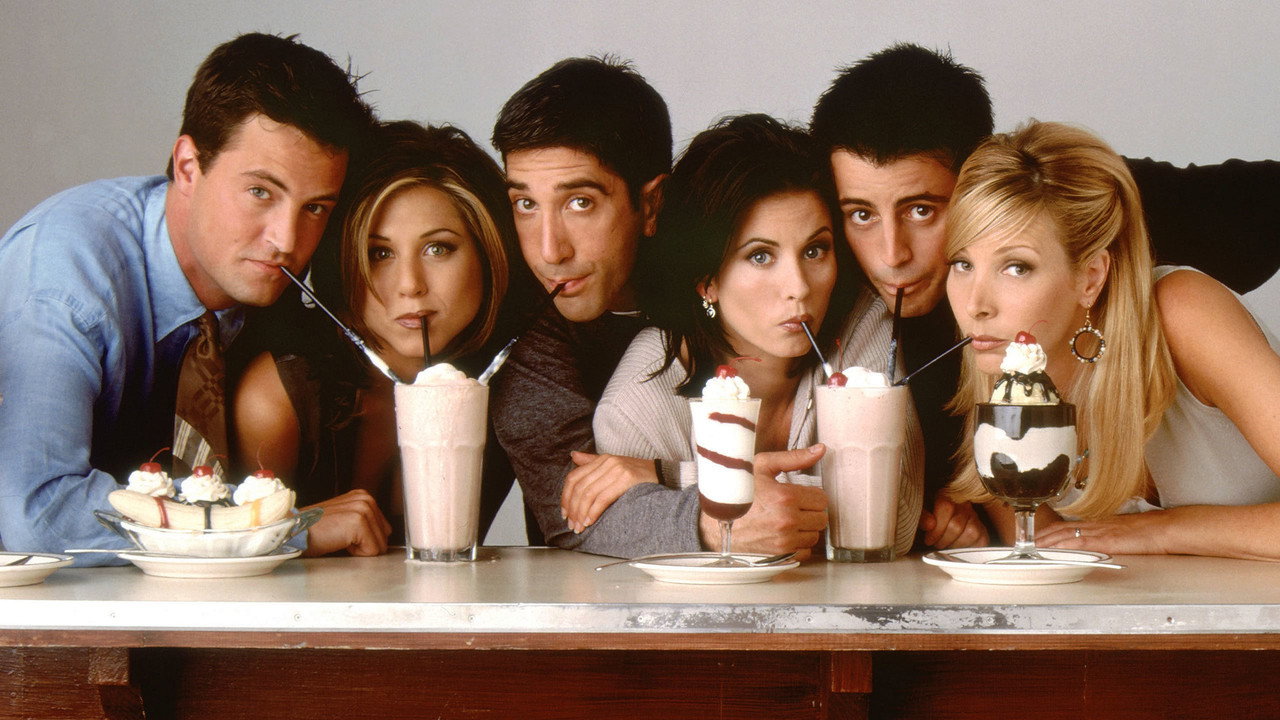

When Friends premiered in 1994, it quickly became more than a hangout sitcom. The series built its identity around six characters whose lives were ordinary enough to feel recognizable and specific enough to become shorthand for an entire era of television. What makes the show endure is not just the broad idea of young adults in New York, but the way it turns apartments, coffee shops, and recurring social rituals into a tightly constructed world with its own rules, rhythms, and emotional logic.
The show’s most familiar episodes work because they combine very small character details with big comic reversals. A lost pet, a couch that will not fit up the stairs, a wedding day disaster, or a simple game can become the centerpiece of a memorable half-hour. That balance helped Friends develop a reputation for episodes that feel instantly readable on the surface while still revealing something precise about the characters underneath.
A six-character ensemble built around clear contrasts
Friends is structured around six central roles, and each one is defined by a distinct comic and emotional function. Monica Geller is the organizer and perfectionist, Ross Geller the awkward academic, Rachel Green the fashion-driven newcomer, Chandler Bing the wisecracker, Joey Tribbiani the actor with a straightforward outlook, and Phoebe Buffay the eccentric outsider with her own private logic. Those contrasts are not just personality markers; they create the series’ basic engine, since different combinations of the six naturally produce different kinds of scenes.
The setup also lets the show move between intimacy and group comedy without losing momentum. A scene in Monica’s apartment can feel like a private conversation between two characters, but it can also shift into a full-circle ensemble moment with all six in the room. That flexibility is one reason the series could support both relationship stories and more self-contained comic episodes without abandoning its core identity.
The apartments are as important as the cast
The show’s visual world is unusually dependent on two recurring spaces: Monica’s apartment and the coffeehouse Central Perk. Monica’s apartment functions as the main domestic hub, the place where birthdays, confessions, arguments, and group gatherings repeatedly happen. It is large enough to accommodate ensemble scenes yet intimate enough to make the characters’ friendships feel lived-in and habitual.
Central Perk, by contrast, gives the series a public-but-familiar setting where the group can gather without the obligations of home. The couch becomes a kind of social anchor, a place where dialogue can unfold in a loose, conversational style. The repeated return to these locations helps the show create a sense of routine, which is part of why even the most outlandish plots still feel grounded in a recognizable everyday rhythm.
Ross and Rachel gave the series a long-running emotional spine
Among the show’s many storylines, Ross and Rachel’s relationship remains the most persistent serialized thread. Their connection begins before the pilot and continues through breakups, reconciliations, misunderstandings, and the kind of timing problems that sitcoms are built to exploit. Because the pair are so different in temperament, the relationship can alternate between sincerity and comedy without feeling artificial.
What makes their arc notable is that it gives the series a stronger emotional throughline than many classic sitcoms of the period. Even when an episode is built around another character’s problem, the Ross-Rachel thread keeps the audience aware that the series is moving through a larger relationship history. That structure helped the show combine episodic comedy with a more serialized sense of consequence.
The famous holiday and event episodes often use one strong idea
Many of the series’ best-known episodes are built around a single high-concept setup. A turkey on a head, a holiday in which the group recalls a shared memory, a contest over who knows the group best, or a game with escalating stakes gives the writers a clear framework for character-based comedy. The premise is often simple enough to explain in a sentence, but the humor comes from the way each character reacts according to established traits.
This approach also makes the episodes easy to remember. Instead of relying on broad plot mechanics, the show often centers an episode on an object, a rule, or a social situation. That gives the comedy a sturdy shape, while the character dynamics supply the variation. It is one reason these episodes continue to be among the most rewatched and quoted in the series.
Physical comedy matters as much as dialogue
Friends is often remembered for its dialogue-driven humor, but many of its most effective scenes depend on physical comedy and precise timing. Joey’s body language, Ross’s increasingly frazzled reactions, Monica’s kinetic frustration, and Phoebe’s unexpected gestures all contribute to the show’s rhythm. The writing may set up the joke, but the visual execution is what often makes it land.
Some of the series’ most recognizable moments are not elaborate set pieces so much as accumulations of small movements and reactions. A pause at the wrong time, a poorly timed entrance, or a prop that becomes an obstacle can generate as much laughter as a punchline. That physical element is part of why the show still reads clearly even when the dialogue is already familiar.
Secondary characters gave the world a wider comic range
The series uses a strong supporting roster to widen its tone and stakes. Janice, Gunther, Carol, Susan, Frank Jr., and Estelle each contribute a different form of comic or emotional pressure. Some are recurring romantic complications, some are workplace or friendship extensions, and some work mainly by disrupting the main group’s assumptions. Together, they keep the world from feeling sealed off around the six leads alone.
These characters also help the show vary its tone without losing continuity. A supporting character can push an episode into romantic awkwardness, family tension, or workplace absurdity, depending on the situation. Because the recurring cast is so distinct, their appearances often do narrative work quickly, allowing episodes to move from setup to payoff with very little exposition.
The show’s style favors clarity over visual complexity
Friends is not a visually flashy series, and that is part of its strength. The camera work generally keeps attention on faces, reactions, and group spacing rather than on elaborate stylistic flourishes. That straightforward approach suits the writing, which depends on timing, ensemble interplay, and the readable geography of recurring spaces.
The result is a series that feels clean and easy to follow even when the situation is complicated. Characters can move in and out of conversations, but the viewer always knows where everyone stands in relation to each other. That clarity is especially useful in episodes built on misunderstandings, as the audience can track who knows what, who is hiding what, and who is about to be caught off guard.
Its most famous episodes are memorable because they are character tests
The episodes most closely associated with Friends are rarely just premise exercises. Even when the story is built around a comic stunt or holiday frame, the real interest comes from how the characters reveal themselves under pressure. Monica’s competitiveness, Chandler’s defensive humor, Rachel’s romantic uncertainty, Joey’s easy charm, and Ross’s neurotic determination all become clearer when the episode pushes them into an unusual situation.
That is why the show’s biggest episodes tend to remain durable in memory. They do not simply present a funny event; they put the group’s relationships in a form that exposes habits, loyalties, and blind spots. The result is a sitcom whose most famous moments are entertaining on first viewing but also revealing of the larger structure that keeps the series going.