
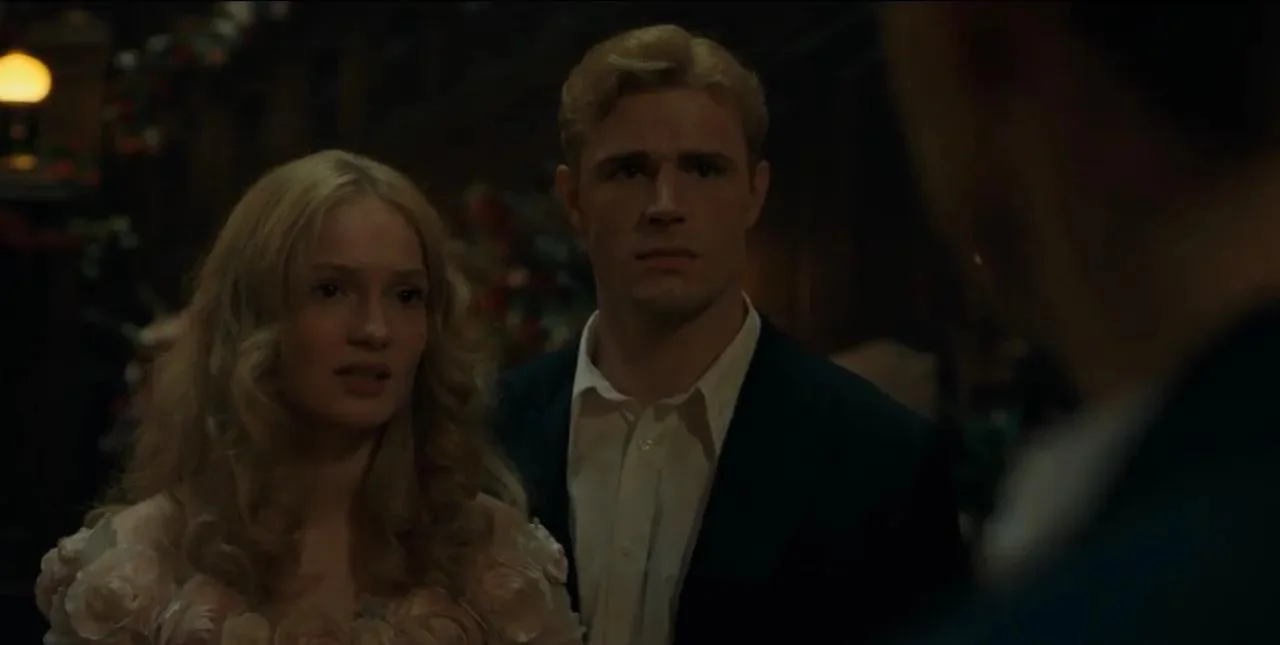

The final stretch of Flowers in the Attic: The Origin leaves a heavy, unsettling impression rather than a clean sense of closure. The story narrows its focus to Olivia Foxworth’s final choices, showing how years of loss, resentment, and rigid belief harden into something irreversible. By the time the series ends, the groundwork for the original Flowers in the Attic story has been firmly and deliberately laid.
The final moments of Flowers in the Attic: The Origin and where the story leaves off
In the closing scenes of Flowers in the Attic: The Origin, Olivia Foxworth is shown fully settled into her role as the unquestioned authority within Foxworth Hall. The household operates under strict rules, and fear rather than affection governs daily life. The children are physically present but emotionally subdued, responding to Olivia with obedience rather than warmth.
The series ends without a dramatic escape or sudden downfall. Instead, it shows stability of a disturbing kind: the system Olivia has created is now firmly in place. This ending emphasizes that nothing is about to change, and that the conditions necessary for future tragedies already exist.
Olivia Foxworth’s transformation by the end and what she ultimately embraces
By the end, Olivia has completed her transformation from a grieving, wounded woman into a rigid enforcer of moral and religious authority. In the final episodes, she actively chooses punishment and control over compassion, even when presented with opportunities to soften her stance. Her actions toward the children are deliberate and calculated, not impulsive.
On screen, Olivia is shown enforcing isolation and discipline without hesitation. She no longer questions whether her methods are justified. The ending makes it clear that she has embraced cruelty as righteousness, convincing herself that suffering is necessary to preserve order and purity.
How Malcolm Foxworth’s influence shapes the outcome of the finale
Although Malcolm Foxworth is no longer physically present in the later scenes, his influence dominates the ending. His teachings, expectations, and emotional abuse are echoed in Olivia’s behavior. The series shows that Olivia’s belief system is largely inherited from Malcolm, even as she enforces it alone.
In the finale, Olivia frequently invokes ideas Malcolm once emphasized: control, punishment, and moral superiority. His absence does not weaken his power over her decisions. Instead, the ending suggests that Malcolm’s worldview has fully taken root, shaping the environment long after his direct involvement ends.
The significance of the children’s fate as the series reaches its conclusion
The children’s fate is shown through implication rather than explicit narration. In the final scenes, they remain confined within the Foxworth household, subject to Olivia’s authority and religious doctrine. Their behavior reflects fear, resignation, and learned obedience.
What matters most is that the children are not rescued or protected by any outside force. The ending confirms that they are trapped in a system designed to suppress them emotionally and physically. This directly mirrors the conditions later faced by the grandchildren in Flowers in the Attic, making the children’s fate a crucial narrative bridge.
What the ending reveals about control, cruelty, and moral justification
The final scenes explicitly show Olivia enforcing harsh discipline while framing her actions as moral duty. She administers punishment calmly, without visible doubt or emotional struggle. This presentation makes it clear that cruelty has become normalized within her worldview.
The series ending does not suggest that Olivia sees herself as cruel. Instead, it shows how she justifies her actions through rigid belief and authority. Control is portrayed not as a side effect, but as the central goal, with morality used as its justification.
The role of religion and punishment in Olivia’s final decisions
Religion is front and center in the final episodes. Olivia repeatedly references sin, redemption, and obedience as reasons for her actions. The ending shows her using religious language to legitimize isolation and suffering, particularly toward the children.
On screen, prayer and punishment are closely linked. Acts of discipline are framed as acts of faith, leaving no room for mercy or flexibility. The finale confirms that religion, as Olivia practices it, has become a tool for domination rather than guidance.
How the closing scenes directly set up the events of Flowers in the Attic
The ending deliberately aligns with the opening conditions of Flowers in the Attic. Foxworth Hall is now a place of secrecy, fear, and strict moral codes. Olivia’s role as the cold, authoritarian grandmother is fully established.
By showing the household in this state, the series creates a direct narrative handoff. There is no ambiguity about how the later story becomes possible. The emotional and structural foundation for future abuse is already complete by the final frame.
What the last images imply about the Foxworth family’s future
The final images emphasize stillness and order rather than chaos. Olivia stands in control, the children remain silent, and the house itself feels sealed off from the outside world. These visuals imply a future defined by repetition rather than change.
Nothing in the ending suggests intervention or redemption. Instead, it implies continuity, with cycles of punishment and obedience continuing unchecked. The Foxworth family’s future is presented as bleak not because of uncertainty, but because of certainty.
Which parts of the ending are left deliberately unresolved
While the ending clearly establishes conditions and character positions, it avoids resolving the emotional inner lives of the children. Their thoughts, hopes, and potential resistance are left unspoken. The series also does not depict the precise events that follow immediately after the finale.
This lack of resolution is intentional. The story stops once the environment is fully formed, leaving the consequences to unfold in Flowers in the Attic. By ending here, the series reinforces the idea that the true horror lies not in a single act, but in the sustained system Olivia has chosen to uphold.
