
Pirates of the Caribbean: The Curse of the Black Pearl did more than revive a dormant Disney brand. It turned Captain Jack Sparrow into a modern movie icon, the kind of character whose voice, gait, and odd little pauses became instantly recognizable even outside the franchise. The film’s success is often credited to spectacle, but its lasting pop-culture footprint rests just as much on one carefully built performance and the movie’s willingness to let that character be stranger than a typical action hero.
Jack Sparrow is not introduced as the strongest pirate, the bravest swordsman, or the most dependable ally. He appears as a swaggering opportunist with a questionable sense of direction and a talent for turning every situation into a negotiation. That mix of charm and chaos gave The Curse of the Black Pearl a lead unlike the clean-cut adventurers Hollywood usually favored, and it helped the film feel fresh even as it leaned on familiar swashbuckling traditions.
A pirate who looked like he’d already lived a thousand stories
Jack Sparrow stands out because the movie refuses to make him simple. He is funny, slippery, and self-preserving, but he is not reduced to a punchline. He can improvise an escape, bluff his way through danger, and still seem as if he is always one step away from disaster. That tension makes him memorable: he behaves like a man who has survived by instinct rather than discipline, and the film never smooths away that instability.
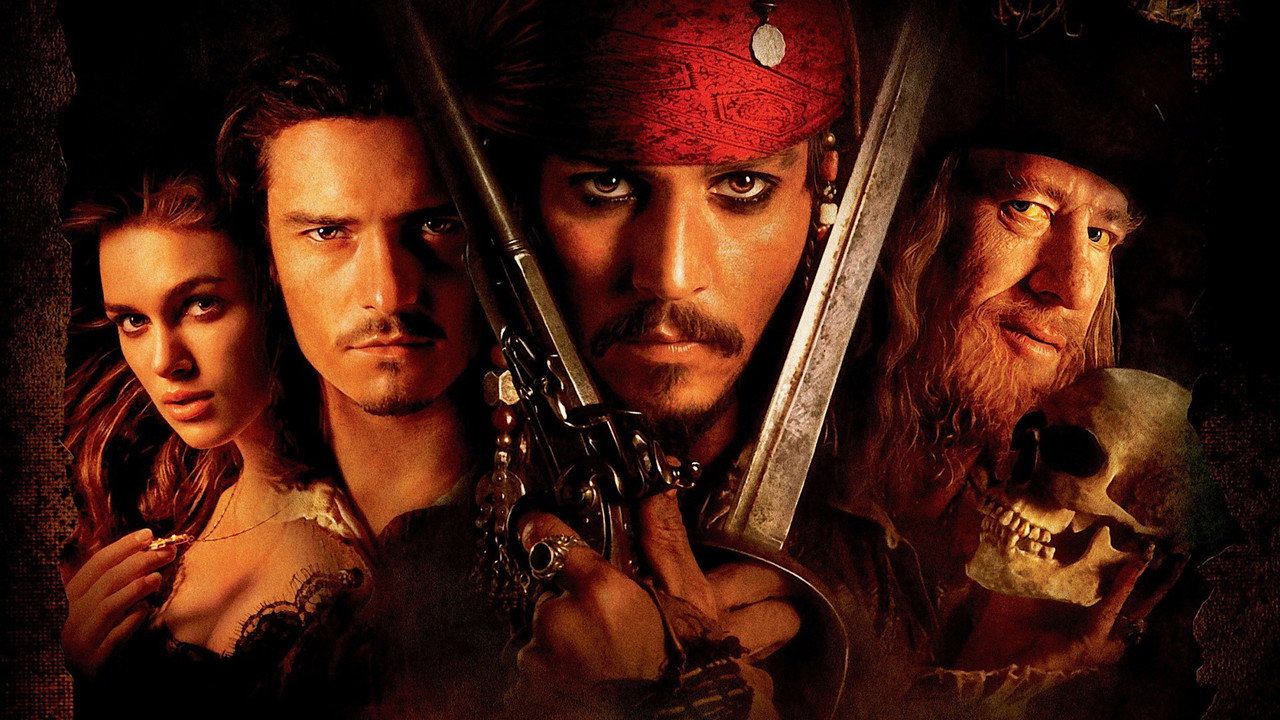
His look matters as much as his dialogue. The braided hair, beads, kohl-lined eyes, rings, weathered clothes, and compass all contribute to the sense that he has assembled himself from scraps of different lives and legends. The costume design gives him the appearance of someone who belongs to the sea without looking polished enough to be romanticized in a traditional way. Even before he speaks, he signals that this is not going to be an ordinary adventure hero.
Johnny Depp’s performance changed the movie’s center of gravity
Johnny Depp’s portrayal became the engine that made Jack Sparrow feel singular. He plays him with a loose physical rhythm, slurred confidence, and a voice that seems to drift between performance and improvisation. That choice makes Jack feel perpetually off-balance, yet still strangely in control when it matters. The performance is built on contradiction: he looks like he is winging everything, but he often knows exactly what he is doing.
What made the character resonate was not just eccentricity, but precision. Depp gives Jack tiny pauses, glances, and changes in posture that suggest he is constantly reading the room and recalculating his next move. The result is a character who can be comic, cunning, and unexpectedly capable in the same scene. That balance helped Jack become the most recognizable figure in the franchise, even though the story belongs to several characters at once.
The script gave Jack room to be clever instead of noble
Part of the character’s appeal comes from how the screenplay frames him. Jack is not asked to behave like a classic hero whose moral clarity drives the story. He is more useful than heroic, and often more persuasive than sincere. The movie keeps placing him in situations where his self-interest and the needs of others overlap, which allows him to remain unpredictable without seeming arbitrary.
That structure gives him an unusual kind of agency. He is frequently the least trustworthy person in the scene, but he is also the one with the most information about how the pirate world functions. His knowledge of ships, codes, and survival tactics makes him valuable to Will Turner and Elizabeth Swann, even when neither of them can fully trust him. The character works because the film makes intelligence, not virtue, his main currency.
He fit into a story that mixed gothic menace with adventure comedy
The Curse of the Black Pearl creates a world where the absurd and the eerie sit side by side. The cursed crew of the Black Pearl, with their skeletal transformations in moonlight, gives the movie a supernatural threat, while Jack’s manner keeps the tone nimble and playful. He becomes the bridge between those two registers. Without him, the film might tilt too far toward dark fantasy; with him, the supernatural elements feel like part of a larger comic adventure.
The movie’s tone also lets Jack behave like a trickster rather than a conventional swashbuckler. He can stroll into danger with theatrical confidence, then retreat through some half-planned escape. That flexibility allows the film to move between sword fights, chases, and deadpan humor without losing momentum. Jack Sparrow became recognizable because he belongs fully to this tonal blend; he is the personification of the film’s refusal to stay in one lane.
The Black Pearl itself helped define who Jack is
Jack’s character cannot be separated from the ship he wants back. The Black Pearl is not merely transportation; it is his identity, his history, and his proof of status in the pirate world. The movie makes the ship feel almost like an extension of his personality: fast, elusive, hard to pin down, and capable of vanishing when least expected. His obsession with reclaiming it gives the character a clear emotional and practical goal.
That relationship also deepens the sense that Jack is not just a wanderer. He has been wronged, displaced, and reduced to improvisation, and the Black Pearl represents the life he lost. The fact that the ship is tied to the film’s larger curse and conflict gives his motivation extra weight. He may seem like he is making everything up as he goes, but the movie roots him in something concrete: a possession, a reputation, and a past that refuses to stay buried.
Jack Sparrow works because the movie never makes him the only point of view
One reason Jack became so memorable is that The Curse of the Black Pearl does not flatten the rest of the cast to make him bigger. Will Turner and Elizabeth Swann have their own stakes, and their presence keeps Jack from becoming the sole center of the narrative. Will gives the story a grounded, earnest counterpart to Jack’s opportunism, while Elizabeth’s intelligence and adaptability make her more than a damsel in distress. Their interactions sharpen Jack’s edges by comparison.
The film also understands when to withhold him. Jack often enters a scene late, leaves early, or seems to be pursuing a different agenda from everyone else. That selective presence makes him feel less like a standard protagonist and more like a force the story has to accommodate. He is central without being totalizing, and that balance is part of why the character became so reusable across sequels and pop culture references.
A design built for imitation, but hard to copy well
Jack Sparrow quickly became one of cinema’s most imitated characters because he is defined by visible traits: the walk, the cadence, the eye movement, the layered costume, the reluctance to commit directly to anything. Those elements are easy to recognize and mimic in fragments, which is why the character spread so rapidly beyond the film itself. Even people who have not followed the franchise closely can usually identify Jack from a single pose or line delivery.
But the character’s real strength is harder to reproduce. He is not just a collection of quirks; he is a carefully calibrated mix of vanity, intelligence, cowardice, luck, and tactical courage. Remove the surrounding story, and the performance can seem like an assortment of eccentric choices. In the context of The Curse of the Black Pearl, though, those choices lock into place and create a character who feels larger than the movie’s premise and more distinctive than the genre usually allows.
Why Jack Sparrow still defines the film’s identity
Even though the movie includes undead pirates, sword duels, naval pursuits, and a romantic adventure plot, Jack Sparrow remains the element most people remember first. That is partly because he is visually striking, but it is also because he represents the film’s main invention: a pirate hero who is neither noble nor villainous, but permanently in motion between those roles. He is difficult to classify, which makes him hard to forget.
That ambiguity gave Pirates of the Caribbean: The Curse of the Black Pearl its enduring identity. The film did not just create a popular character; it built a world where a character like Jack Sparrow could exist and command the screen without behaving like anyone else in the room. The result is one of those rare performances that becomes inseparable from the movie around it, and the reason the character still feels instantly recognizable two decades later.