
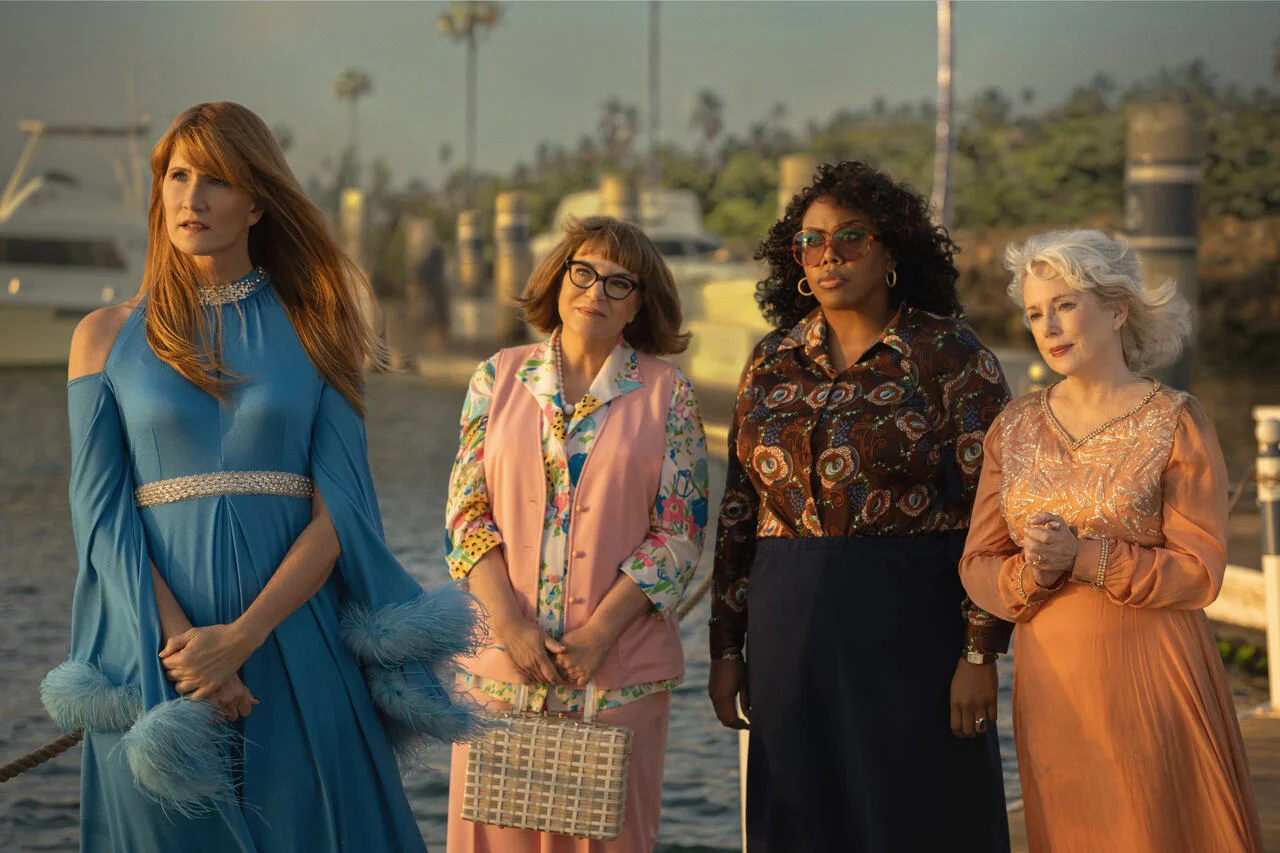

After its initial run, Palm Royale has settled into an unusual position. The series does not end with a clear announcement of continuation, but it also stops short of declaring its story finished.
That lack of clarity has left the project in a pause rather than a conclusion, shaped as much by narrative choices as by external decisions that have not yet been fully defined.
The current situation surrounding Palm Royale and the uncertainty about a third season
As things stand, a third season of Palm Royale has neither been confirmed nor officially ruled out. The series was produced and released as a self-contained season that adapts its core material without explicitly setting up a guaranteed continuation. Since the end of the latest episodes, there has been no formal statement positioning the show as either renewed or concluded.
This places the project in a state of uncertainty rather than cancellation. The absence of forward-looking announcements suggests that a third season is not actively in development, but it does not establish a definitive endpoint. For now, the series exists as a completed chapter with its future unresolved.
What has been officially communicated about the future of the series so far
To date, no official renewal announcement has been made by Apple TV+ or the creative team behind Palm Royale. Public comments from those involved have focused primarily on the existing season rather than on plans beyond it. The lack of explicit messaging about continuation has been notable, especially in contrast to shows that are quickly positioned as ongoing.
Equally important is what has not been said. There has been no confirmation that the series was designed as a limited project, nor has there been language framing it as a completed one-off. This silence leaves room for interpretation but does not provide concrete evidence of active plans for a third season.
Why a continuation beyond the existing story has not been confirmed
One reason a third season has not been confirmed lies in how the existing story was structured. The season adapts its central narrative arc in a way that feels largely resolved by the end. Major plotlines reach clear stopping points, reducing the immediate narrative pressure for continuation.
Another factor is that the series does not end with a strong cliffhanger. While some character dynamics remain open-ended, there is no unresolved crisis or abrupt interruption that demands a follow-up. From a production perspective, this makes continuation optional rather than necessary, allowing the project to pause without appearing incomplete.
Where the story and main character arcs currently stand
By the end of the season, Maxine Simmons has firmly established her position within Palm Beach high society. Her initial outsider status, which drives much of the early tension, evolves into a more complex form of belonging. Rather than achieving uncomplicated acceptance, Maxine secures influence while also confronting the personal cost of that success.
Key relationships reach moments of clarity rather than rupture. Alliances formed through social maneuvering stabilize, and conflicts rooted in status and reputation settle into a new equilibrium. The story closes with Maxine embedded in the world she sought to enter, but without portraying that outcome as purely triumphant. This functions as a stopping point that reflects transformation rather than open conflict.
Factors that may influence whether the series continues or remains limited
Narrative completeness is one of the strongest factors shaping the series’ status. The season tells a cohesive story that does not rely on future episodes to feel whole. This gives the creators flexibility to treat the project as limited if no further direction emerges.
External considerations also matter. Decisions about continuation depend on broader platform strategy, audience response, and how the series fits alongside other projects. While these factors are not publicly detailed, their impact is implicit in the lack of immediate renewal. The absence of urgency suggests that continuation would require deliberate reconsideration rather than automatic extension.
What could realistically change if the project were reconsidered in the future
From a narrative standpoint, a third season would likely require a shift in focus rather than a direct continuation of the same arc. The story leaves room to explore Maxine’s life after her social ascent, particularly the long-term consequences of her choices and the fragility of her position. These threads are open in principle, even if they are not pressing.
Any return would need a clear creative rationale, such as reframing the story around a new phase of Maxine’s ambitions or introducing conflicts that challenge the stability reached at the end of the season. Without that narrative reorientation, continuation risks undermining the sense of completion already achieved. For now, those possibilities remain theoretical, grounded in story logic rather than in confirmed production plans.
Taken together, Palm Royale currently stands as a series in limbo. Its story reaches a natural pause, and its future depends on whether there is both a creative reason and a strategic decision to move beyond that point.
