
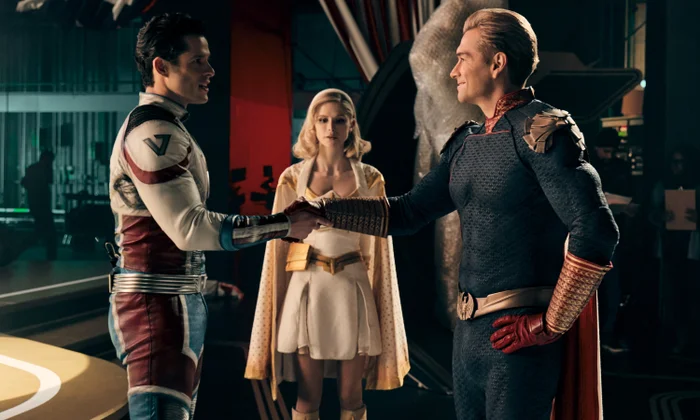

In The Boys, Homelander stands as one of the most complex and terrifying characters in modern television. A twisted mirror of the traditional superhero archetype, he possesses immense power, charisma, and national symbolism. Yet beneath the façade of invincibility lies a fractured psyche, desperate for validation and approval. His obsession with public perception isn’t merely a strategic choice; it’s the foundation of his identity.
Homelander’s need for admiration is so intense that it becomes a psychological vulnerability. His actions—ranging from public performances to acts of brutality—can often be traced back to this core desire: to be loved, feared, and, above all, accepted by the masses. Understanding the roots of this obsession requires a look into his origin, his upbringing, and how power without affection has shaped his view of self-worth.
A childhood engineered in isolation
Homelander wasn’t born; he was made. Raised in a sterile lab by scientists working for Vought International, he grew up without parents, peers, or a nurturing environment. Denied the warmth of a mother or the protection of a father, he was treated as a product—an experiment designed to embody American strength. Human interaction, affection, and emotional development were deliberately withheld, all in the name of creating a controlled and powerful asset.
This lack of human connection created deep emotional scars. Without a parental figure to reflect love and reassurance, Homelander developed a hollow sense of self. Public adoration became the closest thing to emotional validation he ever experienced. Applause replaced affection. Approval ratings substituted for genuine relationships. For Homelander, love became indistinguishable from admiration.
Fame as a surrogate for affection
As the public face of the Seven, Homelander was groomed to be the perfect superhero. Marketing campaigns, media appearances, and curated heroism defined his role. Every smile, every speech, every rescue was designed for maximum PR impact. Over time, he began to internalize this attention as proof of his worth.
Unlike traditional heroes who use fame to amplify their cause, Homelander needs fame to exist. His identity depends on how others perceive him. The slightest dip in public approval sends him into emotional spirals or violent retaliation. He doesn’t simply want to be admired—he requires it to feel real.
The power paradox: omnipotence and insecurity
Homelander is arguably the most powerful being in the show’s universe, yet he’s emotionally fragile. This contradiction defines much of his character. While he can destroy enemies with ease, he’s paralyzed by fear of rejection. His strength isolates him, making genuine connection nearly impossible. He suspects that no one truly cares about him—only about what he represents.
This power paradox fuels his obsession. He needs constant reminders that people love him, even if that love is manufactured. When that adoration wavers, it strikes at the core of his insecurity. He lashes out not from anger alone, but from fear that he’s fundamentally unlovable without his heroic image.
Media manipulation and the illusion of control
Homelander’s life is mediated through cameras, interviews, and choreographed public appearances. Through these platforms, he controls his narrative—or at least tries to. Every heroic act is captured for public consumption, reinforcing his image as protector and patriot. However, this reliance on media creates a fragile illusion. Public perception can shift rapidly, and Homelander knows it.
His obsession is partly rooted in a desire to dominate the narrative before it turns against him. When threatened with bad press or public scandal, he reacts with visible discomfort or aggression. For someone raised to believe perception equals truth, losing control of the spotlight feels like personal disintegration.
Attempts at intimacy that fail
Throughout the series, Homelander seeks connection with a few individuals—Madelyn Stillwell, Queen Maeve, Stormfront—but these relationships are conditional and often manipulative. His fixation on Stillwell, in particular, reveals his hunger for maternal affection. He idolizes her as a comforting authority figure, only to destroy her when he realizes that her affection is conditional.
His inability to form healthy bonds reinforces his dependency on mass adoration. Real relationships require vulnerability and trust—qualities Homelander never developed. It’s easier for him to command applause from millions than to earn love from one person.
Nationalism as emotional camouflage
Homelander’s persona is deeply intertwined with American symbolism. Draped in the flag, he represents not just a superhero but a national ideal. He uses patriotism as a shield, hiding behind slogans and iconography to distract from his instability.
This manufactured nationalism gives him a stage and a script. As long as people conflate him with their country, they’ll cheer for him reflexively. It’s another layer of emotional armor, allowing him to avoid confronting his inner void. The louder the chants of “Homelander! Homelander!”, the easier it is to silence the voice inside that questions his worth.
The fragile balance of fear and love
Eventually, Homelander begins to realize that fear can replace love—but only up to a point. He flirts with authoritarian control, testing how far he can push the public before losing them completely. In one chilling moment, he even claims he could “do anything” and people would still worship him. The moment encapsulates his transformation: no longer desperate to be loved, he’s now curious whether domination can fill the same void.
But even as he explores this darker path, his reactions reveal lingering insecurity. He watches approval ratings obsessively, seeks validation from his son, and reacts with visible emotion to public rejection. Power alone isn’t enough; he wants to be needed and adored.
The psychological toll of being a symbol
Homelander was never allowed to be a person. He was built as a symbol—of strength, safety, patriotism, and perfection. Symbols don’t get to have doubts, flaws, or private emotions. But Homelander does, and this conflict drives much of his psychological unraveling.
The pressure to constantly embody perfection leaves no room for vulnerability. Every failure is a crisis. Every crack in the image is a threat. His obsession with approval is not just vanity—it’s the desperate attempt of a man trying to preserve the only identity he was ever allowed to have.
Reflections in real-world celebrity culture
Homelander’s fixation on public adoration parallels real-world dynamics of fame. Celebrities, political figures, and influencers often rely on approval metrics—followers, ratings, applause—to measure value. When that approval fades, many face identity crises, emotional collapse, or public scandal.
In this light, Homelander represents an exaggerated—but not unrealistic—portrait of someone whose self-worth has been outsourced entirely to public opinion. His descent into manipulation and authoritarianism echoes real concerns about how unchecked power and media obsession can deform character.
Homelander’s obsession with public approval is not just a character flaw—it’s the central thread of his identity. Raised without love, taught to equate admiration with self-worth, and isolated by power, he clings to the crowd’s cheers like a lifeline. Behind the cape and laser eyes is a man who fears that without applause, he is nothing. And that fear, more than his strength, is what makes him truly dangerous.
