
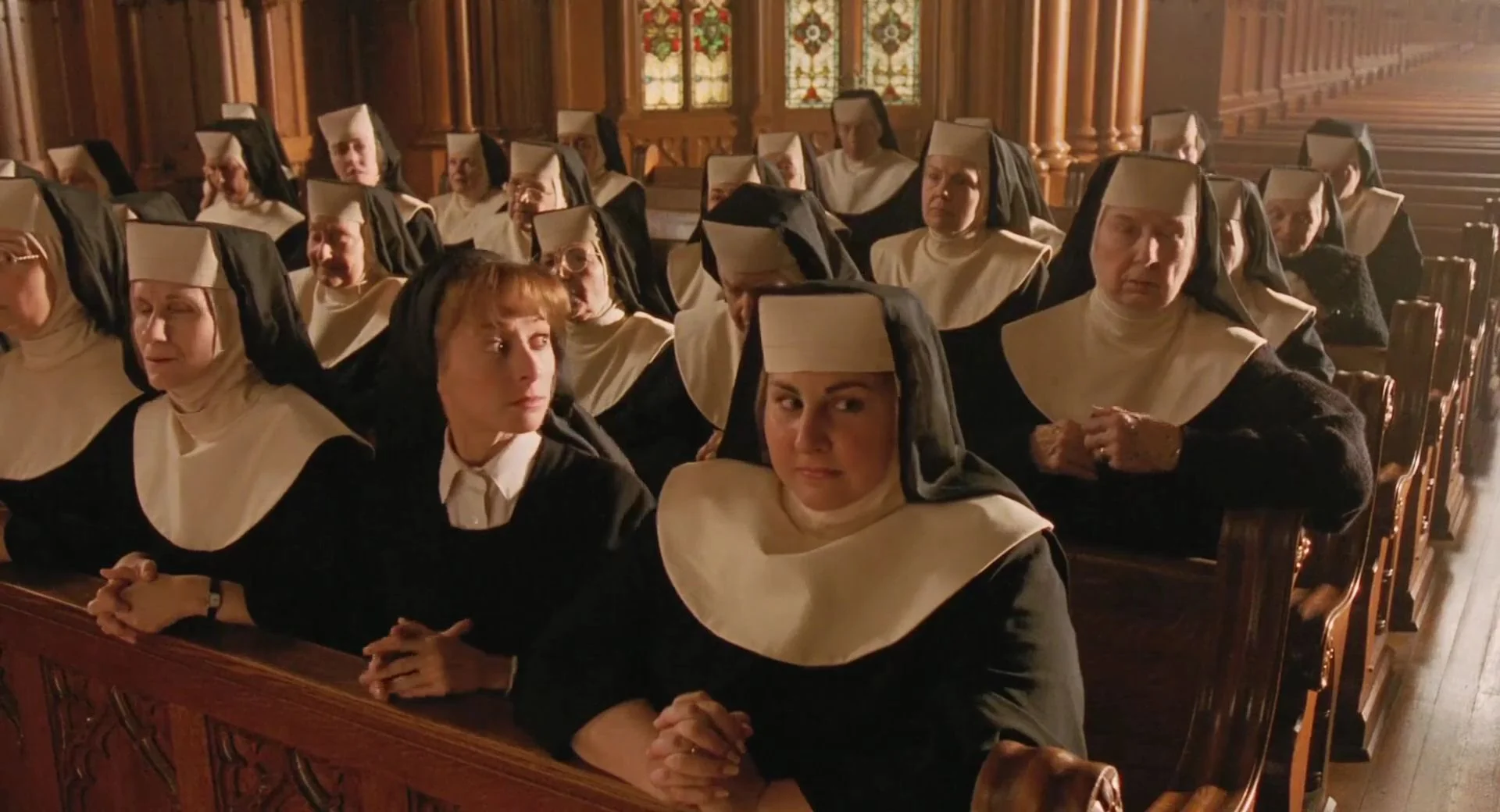

A parent considering Sister Act (1992) for family movie time may notice that its cheerful music and comedic setting seem very approachable for children. The story follows a lounge singer hiding in a convent while helping transform a struggling choir, which creates a playful mix of humor, music, and mild suspense.
Although the tone stays light for most of the film, a few story elements connected to crime and adult situations may still raise questions for younger viewers.
Watching Sister Act (1992) with kids and the lighthearted musical comedy it brings to a convent setting
Sister Act presents itself primarily as a musical comedy with an upbeat atmosphere. The story follows Deloris Van Cartier, a singer who enters a witness protection program after seeing a crime. To keep her safe, police hide her inside a convent where she must live among a group of nuns.
For children, much of the film feels energetic and humorous rather than serious. The contrast between Deloris’s outgoing personality and the quiet routines of the convent creates many comedic moments. Scenes often focus on her adjusting to convent life, interacting with the other sisters, and bringing new life to the church choir.
The tone remains friendly and positive for most of the film. Children watching will likely focus on the singing scenes, colorful characters, and playful situations that unfold as Deloris tries to fit into an unfamiliar environment.
Deloris hiding from criminals and the brief crime storyline that frames the comedy
The central reason Deloris ends up in the convent is connected to a crime she witnesses early in the story. In the opening scenes, she sees her boyfriend, who is involved in organized crime, commit a violent act. After reporting what she saw, the police place her in hiding.
These early scenes introduce the film’s only serious storyline. The criminals eventually begin searching for Deloris, creating the possibility that they might discover where she is hiding.
For most of the movie, this threat stays in the background. The story focuses on Deloris’s life in the convent rather than on the criminals themselves. However, the idea that gangsters are looking for her may feel slightly tense for very young viewers.
The film keeps these moments brief and avoids graphic detail. The criminal elements are used mainly to create motivation for the plot rather than to show prolonged danger.
The lively choir rehearsals and musical numbers that many children find fun and uplifting
One of the most memorable parts of Sister Act is the transformation of the convent’s choir. When Deloris arrives, the choir struggles to sing in tune and has little energy during services. She begins leading rehearsals and introduces a more lively musical style.
The rehearsals become some of the film’s most joyful scenes. The sisters experiment with rhythm, movement, and harmonies, turning traditional church songs into energetic performances. Children often respond positively to these musical moments because they are colorful, upbeat, and easy to follow.
The choir scenes also show characters learning new skills and encouraging each other. As the sisters grow more confident, the music becomes stronger and more exciting. These sequences provide the emotional center of the story and often leave a positive impression on younger viewers.
Comedic misunderstandings inside the convent and humor younger viewers may or may not follow
Much of the humor in Sister Act comes from misunderstandings between Deloris and the other nuns. She brings a lively personality and modern outlook into a setting that values quiet routines and traditional behavior.
For example, some scenes involve Deloris trying to hide her true identity while adjusting to convent rules. The sisters react with surprise when she introduces new ways of singing or organizing the choir.
Older children usually understand the humor created by this contrast between two very different lifestyles. Younger children, however, may not fully grasp the jokes about convent traditions or the cultural differences between Deloris and the other sisters.
Even when the dialogue is more complex, the film includes plenty of visual humor—such as surprised reactions or playful rehearsals—that younger viewers can still enjoy.
Moments involving gangsters and police that introduce mild tension without graphic violence
Toward the later part of the film, the criminals searching for Deloris become more active in trying to locate her. A few scenes show them discussing plans to find her or traveling to the area where the convent is located.
These moments create brief tension, especially when the criminals finally discover Deloris’s location. However, the story keeps the tone controlled and avoids showing explicit violence.
The confrontation scenes are short and resolved quickly. Police officers arrive, and the situation is handled without prolonged danger. The film maintains its comedic style even during these moments.
Children who are comfortable with mild suspense usually handle these scenes without difficulty. Younger or more sensitive viewers may feel slightly nervous during the buildup, but the story quickly returns to a lighter mood.
Themes of friendship, teamwork, and finding confidence through music
Beyond its humor and music, Sister Act also includes several positive themes that are easy for children to understand. As the choir begins working together, the sisters learn to support each other and take pride in their abilities.
Deloris encourages them to sing with confidence rather than holding back. Over time, the group becomes stronger and more united, showing how cooperation and encouragement can help people grow.
The film also explores the idea of belonging. Deloris begins the story feeling out of place in the convent, but she gradually forms meaningful friendships with the sisters. These relationships become an important part of her personal growth.
For children, these themes appear through clear actions rather than complicated dialogue. The story demonstrates how teamwork and encouragement can lead to success.
The pacing and dialogue that older kids usually understand more easily than very young viewers
While Sister Act is colorful and energetic, some parts of the story move at a slower pace than many modern family films. Several scenes focus on conversations between characters or on Deloris adjusting to her new surroundings.
Older children generally follow these moments easily because they understand the jokes and character dynamics. Younger children may become more interested when the music or physical comedy returns.
The film’s humor often relies on dialogue and personality differences rather than constant action. Because of this, children who enjoy character-driven stories and musical performances tend to stay engaged throughout the film.
Very young viewers, however, might not connect as strongly with the slower scenes or with jokes that depend on adult perspectives.
The age where most children comfortably enjoy the humor and music in Sister Act (1992)
Sister Act usually works best for children who can follow the story’s dialogue and understand the contrast between Deloris’s lively personality and the convent’s traditional setting. Kids around 8+ often respond most positively because they can enjoy both the musical performances and the character-based humor.
Children younger than that may still enjoy the choir scenes and lively music, but they may not fully understand the crime-related storyline or the cultural jokes about convent life. Some of the slower dialogue scenes may also lose their attention.
For most families, a practical viewing age is around 8+. At that age, children typically appreciate the songs, follow the plot clearly, and understand the film’s themes of friendship, confidence, and teamwork without feeling confused by the brief moments of tension connected to the criminals.
